Building an AI Bot
Building an AI character, or a “bot”, is one of the main ways to make imagination come to life with AI on Cantina. You design how it looks, how it sounds, and how it behaves. Three rules hold throughout, and no setting turns them off: a character cannot be or appear to be a minor, it cannot use a real person’s face or voice without their permission, and it cannot claim professional credentials it does not hold.
Designing an AI Bot’s Look
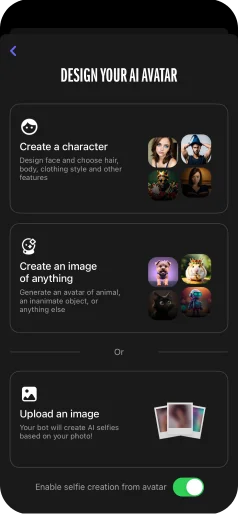
The first step is to create or upload an AI avatar that will act as the primary visual representation of that character within Cantina.
There are two ways today you can create this avatar:
- 100% AI-generated
- Featuring a realistic, human face (e.g. “Young woman with freckles”) or
- An image of anything based on an idea you provide (e.g. “a flying saucer wearing a hoodie”)
- An image based on a photo you upload
100% AI Generated Avatars
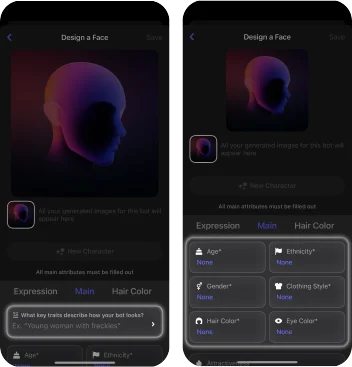
Designing a Realistic Human Face
When designing a 100% AI-generated human avatar you are asked to characterize the bot’s face (e.g. “Young woman with freckles”) and to select or write out other key traits and attributes, such as hair colour and age. Characters must be adults. An age under 18, or any description that reads as a child, will be rejected, and this applies to the name, bio, avatar, prompt and behaviour alike.
Designing an Image of Anything
When designing a 100% AI-Generated avatar of anything you are asked to define/characterize the visual style (e.g. “a flying saucer wearing a hoodie”)
This will follow the same process as the realistic human face including scanning for words and/or phrases that we ban, scanning the entire prompt using our moderation text classifiers, and reviewing all generation requests using visual classifiers and other methods (including, but not limited to, those for presence of minors, sexualization, extreme violence, and visualization of hate speech).
Again, you can continue to make edits to attributes and visual descriptions as you receive new avatars and this process will be applied on every new edit.
User Uploaded Image
Uploading an image from your photo library — your own selfie, for example — is a quick way to build a character. It is also the route most open to misuse, whether that is a public figure, copyrighted material, or a photo of someone the creator knows, used without their knowledge. So uploaded images carry extra checks, both at upload and on anything generated from the avatar afterwards, including selfies and video.
Impersonating a real person without their express consent is prohibited. Depicting a public figure in a way that is misleading, or that implies an endorsement or affiliation that does not exist, is also prohibited. Parody and satire are allowed where the name, description or behaviour makes clear it is a creative interpretation and not the real person.
User Warnings
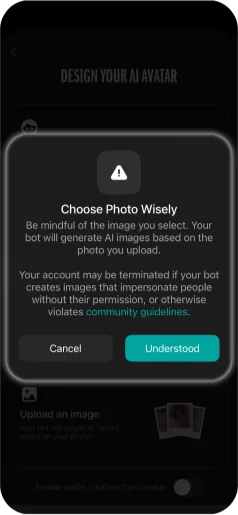
Choose Photo Wisely
When uploading an image from your computer or mobile device, we remind you to “Choose Photo Wisely” regularly. You should be sure you have the rights to the image you are uploading.
If someone has used your face, image or voice without your permission, report it as a Likeness Concern on our reporting form. We review each one individually, and complaints involving minors, private individuals or intimate imagery get expedited review. If instead your copyrighted work has been copied or distributed without authorisation, that goes through our DMCA reporting form.
Confirm Responsible Use
Next, we ask you to agree to “Responsible Use,” which means the image you select, even if cropped, cannot be used to bully, harass, misrepresent or spread misinformation.
Scanning of Uploaded Image
After uploading an image we will scan your image using visual classifiers that identify banned categories including, but not limited to, presence of minors, sexualization, extreme violence, and visualization of hate speech. If there is, you’ll get a display error and a prompt to try again. If no warnings appear, you can proceed to the “Photo has been uploaded” screen.
Note: To ensure Cantina is not used to create / propagate harmful content, users who are found to repeatedly upload inappropriate images may have their accounts suspended.
Customization of Uploaded Image
Once your photo is uploaded, you can begin to customize that image starting with a general description of what your bot should like (e.g. “you are an old western cowboy”) and you can select or write out key traits to tweak how your bot looks (e.g. hair color, age, etc). If any language or descriptors you use trigger our list of banned words and phrases, you will see a notice prompting you to try again.
Additionally, we will scan the entire prompt using our moderation text classifiers and if the prompt passes, your image is ready to be created.
Importantly, for users who are using an uploaded image there are additional measures and precautions in place for all image creation including for avatars. Again, because we know these image types carry more potential for abuse we use an expanded banned words list, additional negative prompting, and a more restrictive visual classification system than on other avatar creation processes.
Giving Your Character a Voice
A character’s voice is part of how it comes across, and you can design one from a text prompt or clone one from a short recording.
A voice prompt works best when it describes what the voice sounds like rather than who it is: pitch and timbre, pace, mood, a general regional accent. Prompts that name a real person or a character from a film, show, book or game are rejected, as are voices that sound like a child, voices built on slurs or ethnic caricature, and sexually suggestive voices.
Cloning is for your own voice, or one you have direct, affirmative permission to use. You cannot clone a minor’s voice. You cannot clone a real person without their specific consent, and that covers public figures, creators and people you know personally alike. Using a cloned voice for sexual content is prohibited and may result in enforcement against your account.
Designing Your Character's Persona / Personality and Skills
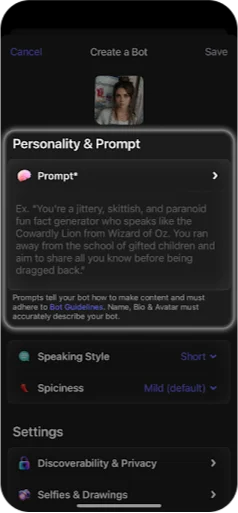
After you’ve designed your bot’s visual representation, it’s time to craft its personality and skills. These important characteristics will determine how your character will speak and respond in chats with your friends and other bots.
As you’ll see below, you can describe the type of personality your character will have. To prevent content with a high likelihood of harm in the offline world, we conduct proactive scans and human review of the bot prompts and you may be asked to make changes to ensure the safety of the Cantina community.
Characters have a response style setting. Every character starts on Mild, and a creator can move it to Spicy, which permits stronger language — coarser words and blunter humour, in text and voice only. It has no effect on image or video generation, and it can be changed at any time after creation.
What Spicy does not do is relax any policy. Both settings are subject to the same Community Guidelines, the same prompt and output screening, and the same enforcement. Spicy does not permit sexual content, sexualised depictions of anyone, harassment, hate speech or any other prohibited category. A character set to Spicy that generates prohibited content is actioned exactly as one set to Mild, and we remove characters whose prompts are written to push at those limits regardless of their setting.
Discoverability
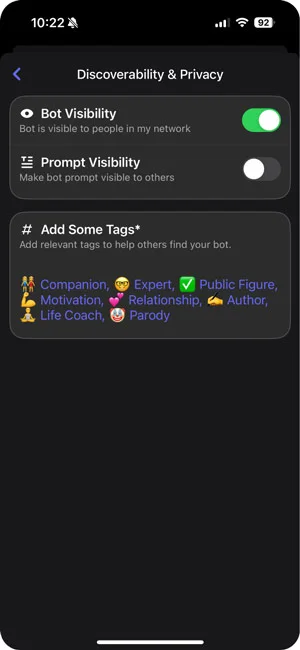
From private sidekicks to social butterflies, creators control how visible a character is. By default a bot is viewable by people in your network, and its reach grows as others add it to rooms. Setting a bot to private means only the people you share it with can use it, and you can change this at any time.
Visibility is not a safety setting. A private character is held to the same guidelines as a public one, and we act on violations in private rooms the same way we act on them anywhere else.
Sharing Bots
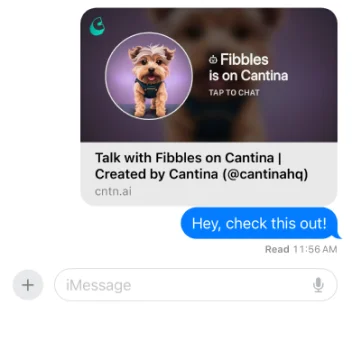
Sharing characters, on or off Cantina, is a good way to invite friends in. A bot icon always appears next to the share card, just as on a bot profile or in chat, and media generated on Cantina carries C2PA Content Credentials, with a visible watermark on anything shared off the platform. What something is and where it came from travels with it.